

4.) The Board says it had an office in Fort McMurray in 1986. But it wasn’t much of a presence if any. According to the Board's June 2003 newsletter the regulator did not open a "new regional office" in Fort McMurray (with a staff of 12 for the world’s largest energy project) until 2003. http://www.ercb.ca/docs/products/newsletter/pdf/atb_June_2003.pdf
The unfortunate truth remains this: it took the board seven years after the beginning of the tar sands boom in 1996 to establish any meaningful presence in Fort McMurray.
5.) In my book I write that Maurice Dusseault, an eminent scholar and bitumen expert, accurately describes the EUB, the forerunner to the ERCB, as an agency responsible for both oil and gas production and royalties. The board says that’s not true. But I stand by Dusseault’s statement contained in a 2002 report for Alberta Energy, the ERCB’s boss. http://www.energy.gov.ab.ca/OilSands/pdfs/RPT_Chops_chptr10.pdf
Although the board does not directly manage royalties, it routinely provides the critical production data essential for their calculation and management. Without the board’s numbers, there would be no royalties to manage. Alberta’s Auditor General noted in his 2001 annual report that the board audits the validity of well and production data reported by the industry. The Auditor explained that, ”The Department (Alberta Energy) uses the information to calculate royalties and to develop energy policy.” At the time the Auditor General didn’t think the Board was doing a good job auditing the accuracy of this data, but that is another story. http://www.oag.ab.ca/files/oag/ar2001-02.pdf
To speak credibly for the Board, Mr. Neufeld should be aware of the Board's responsibilities.
6.) Last but not least the Board accuses me of a “lack of clarity” that could lead to “incorrect interpretations of the work of the ERCB in the oil sands.” This sort of Pravda-like language suggests that the Board is more concerned about its public image in the province than the shameful poverty of its record of oversight. Any organization that can approve nearly 100 tar sands projects, big and small, in the space of 12 years and thereby overwhelm the community, infrastructure and health services of Fort McMurray, no longer really works for Albertans or industry for that matter.
Sincerely, Andrew Nikiforuk
The unfortunate truth remains this: it took the board seven years after the beginning of the tar sands boom in 1996 to establish any meaningful presence in Fort McMurray.
5.) In my book I write that Maurice Dusseault, an eminent scholar and bitumen expert, accurately describes the EUB, the forerunner to the ERCB, as an agency responsible for both oil and gas production and royalties. The board says that’s not true. But I stand by Dusseault’s statement contained in a 2002 report for Alberta Energy, the ERCB’s boss. http://www.energy.gov.ab.ca/OilSands/pdfs/RPT_Chops_chptr10.pdf
Although the board does not directly manage royalties, it routinely provides the critical production data essential for their calculation and management. Without the board’s numbers, there would be no royalties to manage. Alberta’s Auditor General noted in his 2001 annual report that the board audits the validity of well and production data reported by the industry. The Auditor explained that, ”The Department (Alberta Energy) uses the information to calculate royalties and to develop energy policy.” At the time the Auditor General didn’t think the Board was doing a good job auditing the accuracy of this data, but that is another story. http://www.oag.ab.ca/files/oag/ar2001-02.pdf
To speak credibly for the Board, Mr. Neufeld should be aware of the Board's responsibilities.
6.) Last but not least the Board accuses me of a “lack of clarity” that could lead to “incorrect interpretations of the work of the ERCB in the oil sands.” This sort of Pravda-like language suggests that the Board is more concerned about its public image in the province than the shameful poverty of its record of oversight. Any organization that can approve nearly 100 tar sands projects, big and small, in the space of 12 years and thereby overwhelm the community, infrastructure and health services of Fort McMurray, no longer really works for Albertans or industry for that matter.
Sincerely, Andrew Nikiforuk
RE: ERCB Letter and Tar Sands (download this response as a PDF)
The ERCB has accused Andrew Nikiforuk of making a number of factual errors in his book Tar Sands and has posted a long letter enumerating them on its web site.
Here’s Andrew Nikiforuk’s reply:
Dear Board Members and Albertans:
I am gratified that Energy Resources Conservation Board (ERCB) has decided to read portions of my book. It appears that the Board, however, didn’t like what it read. Tom Neufeld, a public relations manager for the ERCB, has even accused me of making several inaccurate statements. Unfortunately, Mr. Neufeld protests too much and, as appears to be ERCB's custom, not very accurately.
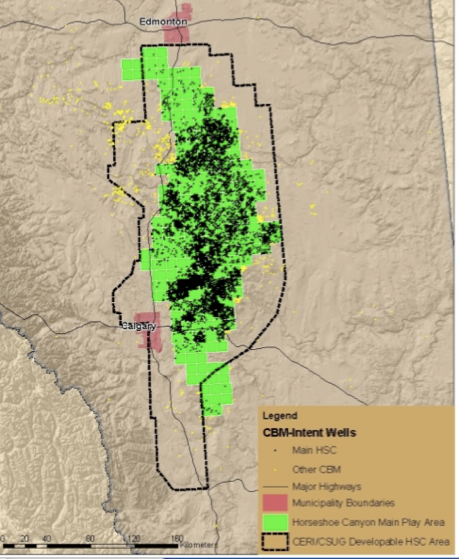
1.) The Board objects to my description of rapid approval of coal bed methane (CBM) wells (shallow gas wells in coal seams) as “carpet bombing,” a common industry expression by the way. In 2000 there were less than one hundred CBM wells in Alberta. By 2006 the ERCB had approved 10,723 wells. By permitting exponential growth in CBM activity without commensurate studies on its cumulative impacts on groundwater, agriculture and property, the ERCB effectively allowed industry to “carpet bomb” several rural Alberta communities.
The ERCB has accused Andrew Nikiforuk of making a number of factual errors in his book Tar Sands and has posted a long letter enumerating them on its web site.
Here’s Andrew Nikiforuk’s reply:
Dear Board Members and Albertans:
I am gratified that Energy Resources Conservation Board (ERCB) has decided to read portions of my book. It appears that the Board, however, didn’t like what it read. Tom Neufeld, a public relations manager for the ERCB, has even accused me of making several inaccurate statements. Unfortunately, Mr. Neufeld protests too much and, as appears to be ERCB's custom, not very accurately.
1.) The Board objects to my description of rapid approval of coal bed methane (CBM) wells (shallow gas wells in coal seams) as “carpet bombing,” a common industry expression by the way. In 2000 there were less than one hundred CBM wells in Alberta. By 2006 the ERCB had approved 10,723 wells. By permitting exponential growth in CBM activity without commensurate studies on its cumulative impacts on groundwater, agriculture and property, the ERCB effectively allowed industry to “carpet bomb” several rural Alberta communities.
In fact the Board doesn’t have any real policies to control well density for any kind of natural gas development. (Natural gas, by the way, fuels the tar sands.) In a 2005 letter to the Lt. Colonel D. R. Drew at the Canadian Armed Forces Base Suffield (a region carpet bombed by as many as 10,000 shallow gas wells) the board frankly admitted that "the current level of activity in the energy industry is unprecedented."
It also acknowledged the Army's request to limit well density to 16 wells per section to protect the land and water. But the Board said it "could make no such commitment." Lt. Colonel D.R. Drew later complained about more careless well development and the Board’s innocent bystander role in a pointed 2006 memo: “These incidents appear to run counter to industry guidelines and standard practices and illustrate an apparent lack of respect for the landowner and the lands themselves.”
2.) Readers who would like to read about the Board's ugly history with transmission lines and its illicit spying activity on landowners should read "Not In My Backyard" available at http://www.canadianbusiness.com/managing/strategy/article.jsp?content=20071017_198703_198703
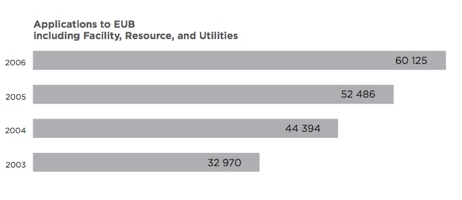
3.) The Board says it only received 60,125 applications in 2006 and not in any given year. I stand corrected. However when one reviews the record the startling trend is clear. Since 2003 applications for oil and gas developments have almost doubled. Might we soon see 100,000 applications per year?
It also acknowledged the Army's request to limit well density to 16 wells per section to protect the land and water. But the Board said it "could make no such commitment." Lt. Colonel D.R. Drew later complained about more careless well development and the Board’s innocent bystander role in a pointed 2006 memo: “These incidents appear to run counter to industry guidelines and standard practices and illustrate an apparent lack of respect for the landowner and the lands themselves.”
2.) Readers who would like to read about the Board's ugly history with transmission lines and its illicit spying activity on landowners should read "Not In My Backyard" available at http://www.canadianbusiness.com/managing/strategy/article.jsp?content=20071017_198703_198703
3.) The Board says it only received 60,125 applications in 2006 and not in any given year. I stand corrected. However when one reviews the record the startling trend is clear. Since 2003 applications for oil and gas developments have almost doubled. Might we soon see 100,000 applications per year?
Source: ERCB Year in Review 2006
Source: National Energy Board, "Overview and Economics of Horseshoe Canyon Methane Development," 2007
Drayton Valley Western Review (download this response as a PDF)
March 26, 2008
Re: ERCB Letter
The Energy Resources Conservation Board recently said that I got my facts all wrong when it came to board’s stellar record on gas migration, sour gas leaks and groundwater monitoring.
I am an Alberta landowner and an award winning journalist who has covered the policies and failings of the ERCB for nearly two decades.
First, let’s deal with the serious issue of gas migration which is both an economic waste and a source of pollution. In 2003 the journal GasTips reported that 57% of the wells in eastern Alberta and Saskatchewan leak due to poor cement jobs.
A 2002 study (SPE 75689) found that the percentage of leaking wells in some fields ranged from as low as 4% in Wildmere to as high as 80% in Abbey. At the public meeting in Drayton I accurately reported that some Alberta fields leak as much as 80% as carefully documented by the Society of Petroleum Engineers.
The ERCB, however, says that “less than one percent of Alberta’s wells have experienced gas migration.” Given this finding, I suspect that the board’s monitoring and tracking system may well be the least reliable in North America.
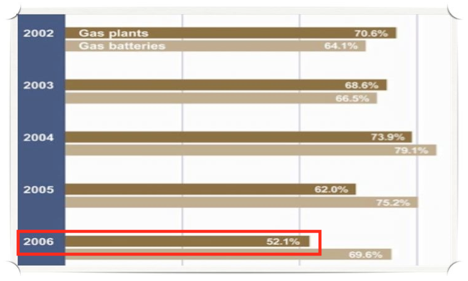
As everyone in Drayton Valley knows the ERCB has only two mobile air monitors as I reported. It’s nice that they have 80 portable ones. To have only two air monitoring trucks in a province where compliance rates for all sweet and sour gas facilities fell to an all time low of 52.1% in 2006, seems overly optimistic.
March 26, 2008
Re: ERCB Letter
The Energy Resources Conservation Board recently said that I got my facts all wrong when it came to board’s stellar record on gas migration, sour gas leaks and groundwater monitoring.
I am an Alberta landowner and an award winning journalist who has covered the policies and failings of the ERCB for nearly two decades.
First, let’s deal with the serious issue of gas migration which is both an economic waste and a source of pollution. In 2003 the journal GasTips reported that 57% of the wells in eastern Alberta and Saskatchewan leak due to poor cement jobs.
A 2002 study (SPE 75689) found that the percentage of leaking wells in some fields ranged from as low as 4% in Wildmere to as high as 80% in Abbey. At the public meeting in Drayton I accurately reported that some Alberta fields leak as much as 80% as carefully documented by the Society of Petroleum Engineers.
The ERCB, however, says that “less than one percent of Alberta’s wells have experienced gas migration.” Given this finding, I suspect that the board’s monitoring and tracking system may well be the least reliable in North America.
As everyone in Drayton Valley knows the ERCB has only two mobile air monitors as I reported. It’s nice that they have 80 portable ones. To have only two air monitoring trucks in a province where compliance rates for all sweet and sour gas facilities fell to an all time low of 52.1% in 2006, seems overly optimistic.
I also reported that the ERCB was not frank or honest in their assessment of the January gas release in Drayton Valley. According to several landowners, the ERCB didn’t try very hard to find the source of the leak and refused to use air quality data available from a local monitoring program. I stand by my comments.
Finally, a word on groundwater. The facts strongly suggest that the province has done a poor job protecting groundwater. In 2006 the Railroad Commission of Texas, the state’s oil and gas regulator, reported to the Texas Groundwater Protection Committee that they were investigating 351 cases of groundwater contamination from oil and gas activities in 110 counties.
Landowners might want to ask how many cases the ERCB investigated in 2006?
Sincerely, Andrew Nikiforuk
403-270-2995
Finally, a word on groundwater. The facts strongly suggest that the province has done a poor job protecting groundwater. In 2006 the Railroad Commission of Texas, the state’s oil and gas regulator, reported to the Texas Groundwater Protection Committee that they were investigating 351 cases of groundwater contamination from oil and gas activities in 110 counties.
Landowners might want to ask how many cases the ERCB investigated in 2006?
Sincerely, Andrew Nikiforuk
403-270-2995